Gobi Desert Camel Trekking Tour
-
duration:
10 Days -
group size:
4-12 persons
-
Difficulty Rating
Moderate
Overview
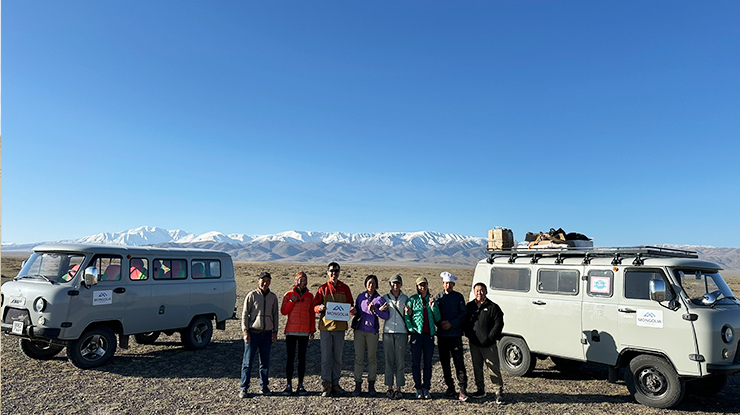
Trek across the desert plains and golden dunes of the Gobi's least-visited reaches atop two-humped Bactrian camels. Guided by Mongolian nomads, travel ancient migration routes as they have for centuries. Hear stories of the land, uncovering the secrets that sustain life in this harsh environment amidst rapid modernization and cultural change.
This camel trek is not measured in speed or distance, but in depth of immersion. Immerse yourself in a nomadic culture refined over generations, in dramatic landscapes, and the quiet magic of unspoiled nature. Camp beneath the vast, star-filled sky and share stories with fellow travelers.
Highlights
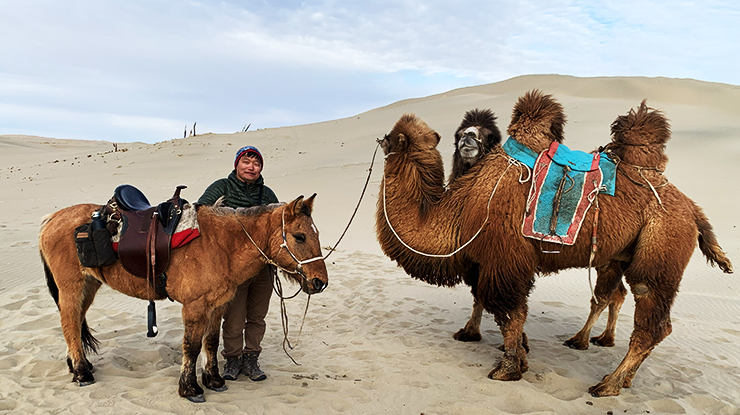
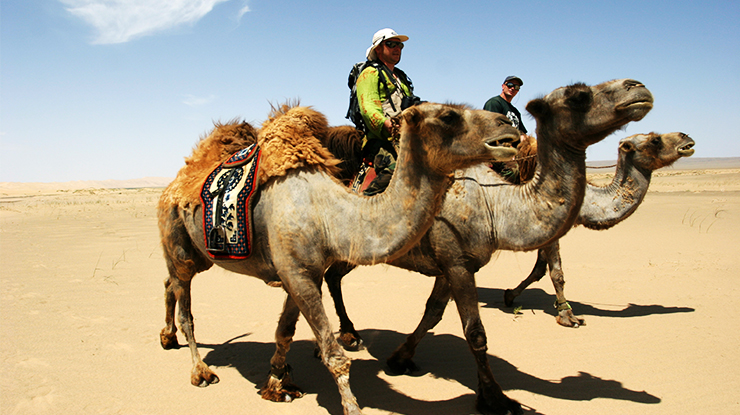
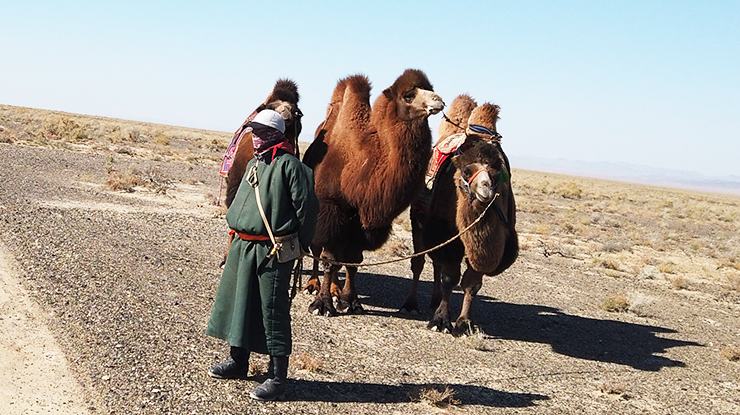
- Ride Bactrian camels across open desert guided by nomadic herders.
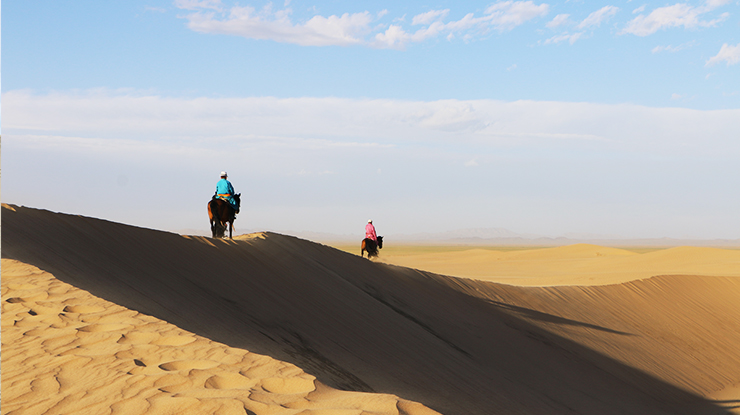
- Trek along sharp-edged crests of the 250-kilometer Mongol Els dunes.
- Discover the cultural codes that sustain life in this harsh environment.
- Camp on the shore of Durgun Lake, between vast water and towering dunes.
- Search for the Saiga antelope, an endemic relic of the Ice Age.
- Share tea & stories in a herder’s tent, experiencing nomadic hospitality.
- Gaze upon the distant, snow-capped peaks from the desert floor.
Itinerary
-
Arrival and Welcome in Ulaanbaatar
On arrival at Ulaanbaatar Airport, meet with our rep and transfer to a centrally located 4-star hotel. Time permitting enjoy an orientation walk of the city center and a guided visit to the National Museum of Mongolia, offering an entertaining journey through Mongolia’s past, from prehistoric cultures and imperial eras to the advent of Buddhism and the modern Communist state. Attend a traditional folk performance featuring Mongolian music, dance, throat singing, and contortion followed by a welcome dinner and a tour briefing by your guide. (Dinner; hotel)
-
Fly to Gobi and travel to Mongol Els Dunes
Accompanied by your guide transfer to Ulaanbaatar airport and catch a 2-hour flight to western part of the Gobi desert where boundless arid plains are alternated by extensive mountain ranges. Contrary to common perception, the Gobi is not a lifeless wasteland. The word Gobi simply refers to an arid region with limited water. Mongolians distinguish 33 different types of Gobi, each defined by its own climate, geology, terrain, plant life, and wildlife. Of these almost 30 of them are fundamentally habitable—a place where people live, herd animals, and maintain a way of life shaped by being mobile, resourceful, and adaptable.
On landing at the desert airport, we drive across open plains toward distant ridges, beyond which lie the Mongol Els dunes. For many travelers, the first encounter with the Gobi is unexpectedly sobering. The vast scale of the rugged land, its apparent emptiness, and the absence of visible life create a sense of isolation that quiets emotion. With growing curiosity, we cross several rocky ridges and arrive at Sangin Lake, a small body of water nestled at the edge of the Mongol Els dunes—one of Mongolia’s largest continuous sand systems, stretching nearly 250 kilometers along the northern rim of the Gobi. Here we establish a tented camp and spend our first evening in this remote and secluded corner of the Earth. (Breakfast, lunch, dinner; tent)
-
Trekking the Mongol Els Dunes
We awaken to the first light of day as the sun rises behind the dark mountain range in the east, and spreads its golden light across the water and the massive dunes emerge directly from the sandy shore. Several waterfowl species appear on the lake—floating quietly, moving along the shoreline, or darting through the air. After a hearty breakfast prepared by the cook, we step onto the dunes and begin trekking along their crests.
Today we explore dunes of striking purity and cinematic scale. At a leisurely pace, we climb and traverse broad slopes of fine sand, gradually revealing a sea of sand beyond the ridgelines, bounded by the faint outlines of the Zavkhan River and distant mountain peaks—a dramatic landscape that makes you feel small. Despite its stark appearance, this is a living environment. Rivers descending from distant ranges and saline lakes support a diversity of insects, birds, and mammals, though they are rarely seen. After covering approximately 15 kilometers, we descend from the dunes and rejoin our camp, which will have relocated to a new site. (Breakfast, lunch, dinner; tent)
-
Trekking the Mongol Els Dunes
Today we cross the dunes and hike to the area’s highest point, Seer Peak, a modest rise reaching 1,830 m above sea level, set amid a sea of sand. Starting around 200 meters lower, we ascend at a leisurely pace, listening to the guide’s insights into local traditions, way of life, wildlife, and plant species. From time immemorial, local nomads have found shelter from the winter weather within the dune folds and grazed their livestock on Psammochloa villosa and Agriophyllum arenarium, highly nutritious plants that grow on the dunes and provide essential winter forage.
From the summit of Seer Peak, the scale of the dune mass is seen in its full extent, boundless and awe-inspiring. After completing the hike, we transfer to Gun Lake, a spring-fed lake enclosed by dunes. Salt harvested here by local herders is used as a mineral supplement for livestock, helping animals build sufficient reserves to endure the winter months. Local herders who will accompany us over the coming days join us this evening with their camels. (Breakfast, lunch, dinner; tent)
-
Camel Trekking to Bichigt oasis
Today we begin our camel trek, riding two-humped Bactrian camels across an open plain that runs parallel to the dunes. The region is inhabited by a seemingly sparse nomadic population that relies on large herds of sheep, goats, horses, and camels—livestock commonly seen along our route. During the hot summer months, nomads favor open, well-ventilated plains close to reliable water sources.
Along the way, there may be an opportunity to visit a herder’s tent, sample local tea and cheese, and chat with the hosts. We continue riding to Ulaan Zuukh, ten miles of escarpment standing like the weatherworn walls of a city built by time. We climb to the top and head toward a small oasis set among sun-burnt rocky ridges, partially buried by drifting sand. This is another place where we can meet local herders when they gather to water their animals. Far on the horizon, the jagged outline of the desert mountains comes into view, marking the distant boundary of the landscape. (Breakfast, lunch, dinner; tent)
-
Camel Trekking to Tsetsen lake
We continue our journey, this time riding along the dunes on soft sandy soil. Rugged ridges, buried in sand drifts, dominate the way. Riding side by side with local nomads immerses you in a way of life refined over generations and gives a deeper understanding of why the nomadic way endures in the face of rapid modernization and sweeping cultural change.
As we make our way across the saddle—the highest point of the day—a view opens before us: an ocean of sand beyond which gleam the 4000-meter-tall, snowy ridges of the Bumbat and Jargalant mountains, lying 100 kilometers away. Tonight, we camp at Tsookhor, a small salt lake at the edge of the dunes in the rare stillness of one of Mongolia’s least-visited regions. Abundant reeds and a few desert trees grow along the lakeshore, with the magnificent perspective of the Bumbat and Jargalant mountains as backdrop. (Breakfast, lunch, dinner; tent)
-
Trek to Durgun Lake
On our last riding day we cross a barren plain, but significantly, the Gobi soil can preserve plant seeds for years if drought persists; as soon as there is rain, vegetation springs up, offering grazing to the animals. It is a common quality of the plants in the Gobi—although not as abundant and lush as in more humid regions, they excel in their nutritious qualities and "power." And so are said the people in this region: though terse and reserved, once befriended one discovers an open soul, a friendly character, and a kind humor.
Our destination is the Durgun Lake, one of the dozen big lakes that make up the depression of the Great Lakes. Measuring 25x20km, this 300-square-km body of water is skirted by the Mongol Els dunes on its east side. To the north, it is linked by a long, wide straight to the even larger Khar Nuur Lake. The camel riding adventure concludes at a campsite on the narrow shoreline of Durgun Lake, nestled between its vast water expanse and the Mongol Els dunes. (Breakfast, lunch, dinner; tent)
-
Return to Altai town
This morning, we bid farewells to our local guides and camels and start driving to Altai town from where we fly back to Ulaanbaatar the next day. We travel across the open desert, heading towards the 4000m Sutai Mountain with its snow cap glistening in the sun. To our west lies the Bumbat Range, its craggy foothills vivid in the crisp morning air. This is the territory of the Saiga antelope, a critically endangered Ice Age relic that roamed the Earth alongside mammoths, woolly rhinos, and giant bison from 2.5 million to 11,700 years ago. Once, they wandered vast lands from the British Isles across northern Eurasia to Alaska. It’s a fascinating example of survival and adaptation.
With just a little luck, you may see them racing along the car track at high speed, turning into a cloud of dust as they cross your path. Upon returning to Altai town, we settle into a comfortable hotel for our last dinner in the Gobi desert. (Breakfast, lunch, dinner; hotel)
-
Flight back to Ulaanbaatar
We board the plane back to Ulaanbaatar. Through the aircraft window, as it lifts into the air, you catch a final glimpse of the wrinkled tapestry of arid earth and the occasional glint of a salt lake—a land harsh in appearance, yet softened by the hospitality of its people. In Ulaanbaatar, you can put the final touches on your journey and shop for gifts before gathering with your fellow travelers to celebrate your Mongolian adventure. (Breakfast, dinner; tent)
-
Departure transfer
It is time to say goodbye to Mongolia. You will be transferred to the airport for your onward journey. We hope you leave with a content heart and pleasant memories. (Breakfast)
Reviews
Susanna & Rainer Hiß (Gobi Desert Camel Trekking Tour)
We were a fantastic team, all of us got along really well, and shared so many wonderful experiences. We had great conversations and amazing moments without even speaking...
All in all, we want to thank you all for making this unforgettable trip possible. Everything went perfectly well, and we are more than satisfied. Our expectations were far exceeded. Thank you for that. Thanks again to all of you, and have a wonderful time.
We would gladly recommend you all.
All Reviews (Gobi Desert Camel Trekking Tour)
Susanna & Rainer Hiß (Gobi Desert Camel Trekking Tour)
We were a fantastic team, all of us got along really well, and shared so many wonderful experiences. We had great conversations and amazing moments without even speaking...
All in all, we want to thank you all for making this unforgettable trip possible. Everything went perfectly well, and we are more than satisfied. Our expectations were far exceeded. Thank you for that. Thanks again to all of you, and have a wonderful time.
We would gladly recommend you all.